Bid Bond vs Performance Bond vs Payment Bond (2026): What Contractors Need Before Bidding the Job
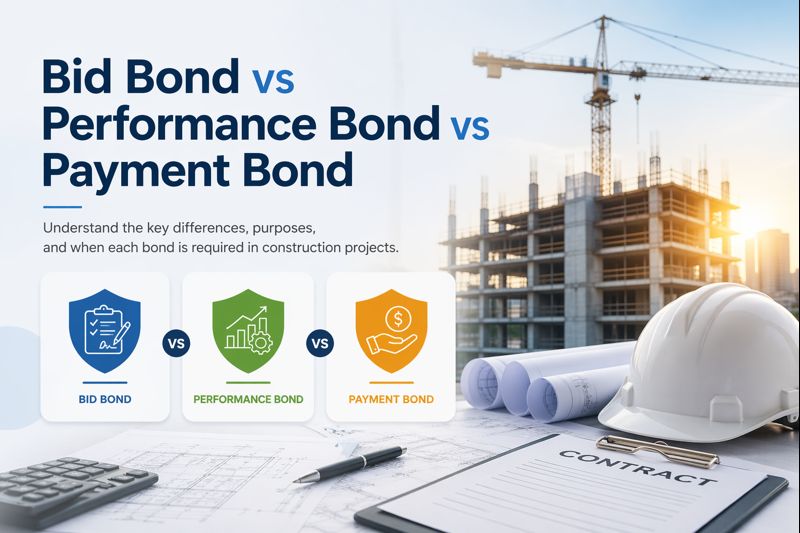
Bid bonds, performance bonds, and payment bonds are the three contract surety bonds contractors see most often on public construction, municipal work, commercial projects, and larger private jobs. They work together, but they do not protect the same party or guarantee the same obligation. A bid bond protects the project owner during the bidding stage. A performance bond protects the owner if the contractor fails to complete the contract. A payment bond protects subcontractors, laborers, and suppliers if they are not paid for covered work or materials.
The fastest way to understand the difference is to follow the project timeline. First, the project owner asks bidders to submit a bid bond with the proposal. If the contractor wins, signs the contract, and supplies the required performance and payment bonds, the bid bond has done its job. Once the contract starts, the performance bond supports the contractor’s promise to complete the work according to the contract terms. The payment bond supports the contractor’s promise to pay covered subs and suppliers.
If you are searching for surety bonds near me, start with the contract documents, bid invitation, bond form, project amount, deadline, obligee name, and whether the job requires bid, performance, payment, maintenance, or license bonds.
Quick facts: bid bond vs performance bond vs payment bond
Use this snapshot to identify which bond your contract requires before you submit a bid or sign the agreement.
| Bond type | Stage | Who it protects | Main promise |
|---|---|---|---|
| Bid bond | Before award | Project owner / obligee | The bidder will honor the bid, sign the contract if awarded, and provide required performance and payment bonds. |
| Performance bond | After award / during project | Project owner / obligee | The contractor will complete the work according to the contract terms. |
| Payment bond | After award / during project | Covered subcontractors, laborers, and suppliers | The contractor will pay covered parties for labor and materials supplied to the project. |
Bid bond vs performance bond vs payment bond: side-by-side comparison
These bonds are not interchangeable. Owners use bid bonds to screen bidders and reduce the risk of a contractor walking away after winning. Owners use performance bonds to reduce completion risk. Subs and suppliers rely on payment bonds because they may not have the same lien rights on public work that they would have on private property.
| Question | Bid bond | Performance bond | Payment bond |
|---|---|---|---|
| When is it required? | With the bid or proposal | After award, before work starts | After award, often paired with performance bond |
| Who is the principal? | The bidder / contractor | The contractor | The contractor |
| Who is the obligee? | The project owner or public entity | The project owner or public entity | The project owner, with claim rights for covered subs and suppliers |
| What triggers concern? | Winner refuses to sign, withdraws improperly, or cannot provide final bonds | Contractor default, abandonment, or failure to perform contract obligations | Covered subs, laborers, or suppliers are not paid |
| What should contractors prepare? | Bid invitation, bid amount, bond form, deadline, and contractor financial snapshot | Signed contract, scope, bond form, project amount, schedule, and underwriting package | Contract amount, supplier/sub exposure, payment terms, and project documentation |
How the three bonds fit into the construction timeline
What underwriters review before issuing a bond
A surety bond is different from a standard insurance policy. The surety is backing your obligation to the project owner, and the contractor generally signs an indemnity agreement promising to reimburse the surety for losses. That is why underwriters look closely at financial strength, experience, capacity, job size, backlog, credit, contract terms, and whether the requested bond matches the contractor’s track record.
| Item | Why it matters | Contractor prep tip |
|---|---|---|
| Contract amount | Determines bond size and capacity impact | Provide bid amount, final contract amount, and any alternates clearly. |
| Financials | Shows liquidity, net worth, working capital, and stability | Keep current financial statements, tax returns, and bank references ready. |
| Experience | Shows whether similar work has been completed successfully | Prepare project history, references, resumes, and completed job examples. |
| Backlog | Shows whether current work leaves enough capacity for the new project | Maintain a simple work-in-progress schedule with start and completion dates. |
| Bond form | Some forms create broader obligations or unusual claim terms | Submit the exact obligee-required bond form before the deadline. |
How much do bid, performance, and payment bonds cost?
Bond cost depends on the type of bond, contract amount, contractor financials, credit profile, experience, obligee requirements, bond form, and surety appetite. Bid bonds may have no separate charge when they are part of an approved contract bond program, while performance and payment bonds are commonly priced as a percentage of the contract amount. The strongest contractors usually qualify for better terms because the surety sees lower risk.
| Factor | How it affects approval | How to improve the file |
|---|---|---|
| Credit and financial strength | Impacts rate, capacity, and documentation requirements | Keep taxes current, reduce surprises, and provide clean financial documents. |
| Project size | Larger jobs require stronger capacity review | Bid within proven experience and explain any growth plan. |
| Contract terms | Risky terms can slow approval or require review | Submit the contract and bond forms early. |
| Past performance | Completed similar jobs support approval | Build a project resume with owner references and final contract amounts. |
Common mistakes that delay bond approval
- Waiting until the bid deadline: Bid bonds often move fast, but underwriters still need accurate project details.
- Sending the wrong bond form: Public owners and GCs may require specific language. Always provide the exact form.
- Confusing insurance with surety: A surety expects reimbursement from the contractor if it pays a valid claim.
- Bidding beyond capacity: A job that is too large for current financials or experience may require stronger documentation.
- Ignoring payment exposure: Payment bonds help protect covered subs and suppliers, so supplier-heavy jobs need clear cost planning.
Surety bond support across our licensed footprint
Blake Insurance Group helps contractors, subcontractors, developers, and business owners compare surety bond options across our licensed states. Requirements vary by obligee, project type, public entity, and contract language, so always review the bid packet and bond form before applying.
| Region | Licensed states | Common bond need |
|---|---|---|
| Southwest and West | AZ, CA, NM, TX | Bid bonds, performance/payment bonds, license bonds, subdivision bonds, and contractor compliance bonds |
| Southeast and Mid-Atlantic | AL, FL, GA, NC, SC, VA, WV | Public construction bonds, GC/subcontractor bonds, commercial project bonds, and maintenance bonds |
| Midwest and Plains | IA, KS, MI, NE, OH, OK, SD | Municipal bid bonds, contractor license bonds, public works bonds, and payment bonds |
| Northeast | NY | Construction contract bonds, obligee-required forms, and project-specific surety review |
Get a bid bond, performance bond, or payment bond quote
The fastest way to start is to gather the bid invitation, project amount, obligee name, bond form, deadline, contract documents, and your current contractor information. If the project requires both performance and payment bonds, quote them together so the underwriting file matches the full obligation.
A bond is not issued until the application is approved, required documents are complete, premium is paid when required, and the surety confirms issuance.
Related topics
Bid bond vs performance bond vs payment bond FAQs (2026)
What is the main difference between a bid bond, performance bond, and payment bond?
A bid bond applies before contract award and guarantees the bidder will honor the bid and provide required final bonds. A performance bond guarantees the contractor will complete the project according to the contract. A payment bond helps ensure covered subcontractors, laborers, and suppliers are paid.
Do I need all three bonds?
Many public and commercial projects require a bid bond at bid submission and then performance and payment bonds after award. Your bid packet or contract documents should identify which bonds are required.
Is a surety bond the same as insurance?
No. A surety bond is a three-party guarantee involving the principal, obligee, and surety. If the surety pays a valid claim, it generally seeks reimbursement from the bonded contractor under the indemnity agreement.
How fast can I get a bid bond?
Timing depends on the bond amount, contractor financials, underwriting file, credit, bid deadline, and bond form. Smaller or established accounts may move quickly, while larger jobs require deeper review.
What documents should I prepare for a performance and payment bond?
Prepare the contract, bond forms, project amount, scope, schedule, financial statements, tax returns if requested, work-in-progress schedule, bank reference, ownership information, and project history.
Independent agency: Blake Insurance Group LLC is an independent insurance agency and surety resource and is not affiliated with any single surety company, carrier, public entity, or obligee.
Licensing: Licensed insurance producer (NPN 16944666).
Important: Bond eligibility, rates, underwriting requirements, indemnity requirements, collateral, limits, bond forms, and issuance timelines vary by surety, state, obligee, contract amount, contractor profile, and project documents. Your issued bond and contract documents govern obligations. This page is general information and not legal, tax, financial, or construction contract advice.
Trademarks: Any carrier, surety, platform, or brand names are trademarks™ or registered® trademarks of their respective owners. Use of these names is for identification only and does not imply affiliation or endorsement.




