Types of Surety Bonds (2026): Contract Bonds, Commercial Bonds, Court Bonds, Official Bonds, and How to Compare Them
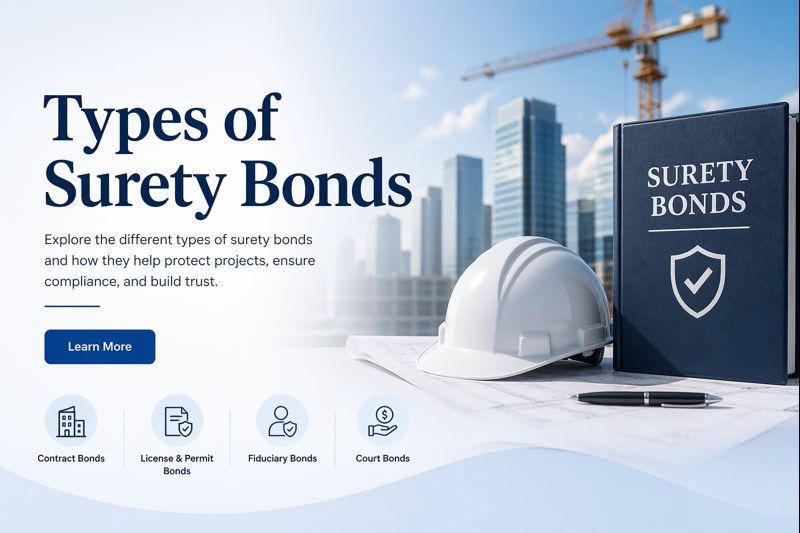
Shopping for surety bonds near me gets confusing fast because “surety bond” is really a category, not one product. Some buyers need a bond for a construction contract. Others need a license bond, a court bond, a public official bond, or another commercial bond to satisfy a legal or business requirement. In 2026, the cleanest way to shop is to start with the exact requirement first, then match it to the right surety bond type.
At the highest level, most buyers will end up in one of two main lanes: contract surety bonds or commercial surety bonds. Contract bonds are usually tied to project performance, especially in construction and public work. Commercial bonds are typically required by a law, government agency, court, or other entity to protect the public or another stakeholder. Once you understand that split, the rest of the category becomes much easier to navigate.
How to classify surety bond types without getting lost
The fastest way to understand surety bond types is to ask one question: “Is this bond tied to a contract, or is it tied to a legal, regulatory, court, or public-duty requirement?” If the answer is a project contract, you are usually in the contract bond lane. If the answer is licensing, compliance, court action, probate, public office, or another statutory or commercial requirement, you are usually in the commercial bond lane.
- Check the requirement source: contract, bid package, state agency, local license office, court, or statute.
- Identify the bond category: contract bond or commercial bond.
- Confirm the exact bond type: bid, performance, payment, license, permit, court, public official, fiduciary, utility, or another named form.
- Match the amount and wording: the obligee usually controls the form, bond amount, and filing instructions.
- Compare quotes on accuracy first: the right bond form matters more than a low price on the wrong bond.
Quick facts: the surety bond categories most buyers run into first
This table gives you the fastest way to sort the major bond families before you drill down into the exact form you need.
| Category | What it usually covers | Common obligee | What to verify |
|---|---|---|---|
| Contract bonds | Project bidding, performance, payment, or related construction obligations | Project owner or public entity | Bid package, contract terms, and bond wording |
| License and permit bonds | Business compliance with laws, codes, or regulations | State, county, or city agency | License class, bond amount, and required form |
| Court or judicial bonds | Protection tied to a court proceeding or legal action | Court | Case details, bond wording, and filing instructions |
| Public official bonds | Faithful performance of public duties | Government body | Office title, term, and statutory language |
| Fiduciary bonds | Protection for heirs, beneficiaries, or creditors when a fiduciary serves under court supervision | Court or estate authority | Role, case caption, and amount required |
| Miscellaneous commercial bonds | Specialized financial or compliance obligations | Agency, private obligee, or utility | Exact bond name and custom form requirements |
Main types of surety bonds buyers commonly compare
Most surety bond discussions eventually collapse into a short list of practical categories. Contract bonds lead the list because they are common in construction and public procurement. Commercial bonds cover a broader field, including license and permit, court, public official, fiduciary, and miscellaneous bond types. The smartest way to compare them is by use case rather than by treating all bonds as interchangeable.
| Bond type | Typical use | Who it usually protects | Watch-out |
|---|---|---|---|
| Bid bond | Supports a contractor’s bid on a project | Project owner | Not the same as a performance bond or payment bond |
| Performance bond | Guarantees contract performance | Project owner / obligee | Must line up with the bonded contract |
| Payment bond | Guarantees payment of certain labor and material obligations | Subcontractors, suppliers, and obligee interests | Common on public work, but not identical to every project requirement |
| License and permit bond | Required to obtain or keep a business license or permit | Public / regulator | Agency naming and amount must match exactly |
| Court bond | Used in legal proceedings | Court and other interested parties | Case-specific wording matters |
| Public official bond | Required for certain officeholders | Public | Office title and term details matter |
| Fiduciary bond | Used when someone administers a trust or estate under court supervision | Heirs, beneficiaries, creditors | Do not confuse it with general business bonding |
| Miscellaneous bond | Specialized private, regulatory, or utility requirements | Varies by obligation | The exact bond name is essential |
Contract surety bonds: bid, performance, payment, and related project bonds
Contract bonds are the side of surety many business owners first encounter when bidding on construction or public work. These bonds are commonly required by governments and project owners to reduce performance risk and keep projects moving. The most recognized contract bond trio is bid bonds, performance bonds, and payment bonds. Depending on the project, a maintenance or ancillary bond may also show up.
| Contract bond | What it usually does | When it appears | Why buyers confuse it |
|---|---|---|---|
| Bid bond | Protects the obligee if the successful bidder will not enter the contract or provide required security | Bid stage | People often think it covers project completion by itself |
| Performance bond | Protects the obligee if the contractor defaults on contract obligations | After award / during performance | Sometimes confused with payment obligations |
| Payment bond | Guarantees certain labor and material bills tied to the project | After award / project execution | People sometimes assume it is the same as performance protection |
| Maintenance bond | Can back post-completion warranty or maintenance obligations | Project closeout / post-completion | Not required on every project |
For small businesses, the SBA’s surety program is relevant here because it guarantees certain contract bonds, including bid, performance, payment, and ancillary bonds for qualifying small businesses. That can matter when a contractor has the work but needs help accessing bonding capacity.
Commercial surety bonds: the broader category most non-construction buyers need
Commercial bonds cover a wider set of legal, compliance, and financial obligations. These are often required by state and local agencies, courts, or statutes, and they usually protect the public, a court, an estate, or another stakeholder. The most common commercial categories buyers encounter are license and permit bonds, court bonds, public official bonds, fiduciary bonds, and miscellaneous bonds.
| Commercial bond category | Common examples | Why it is required | Smart move before quoting |
|---|---|---|---|
| License and permit bonds | Contractor license, auto dealer, mortgage-related, tax, customs, warehouse | Regulator wants compliance protection | Use the exact agency requirement and bond amount |
| Court / judicial bonds | Appeal, injunction, attachment, replevin, bail-related court bonds | Court wants security tied to the proceeding | Match the case details and court form precisely |
| Public official bonds | Treasurers, tax collectors, judges, sheriffs, clerks | Law requires faithful performance of office duties | Verify title, term, and statutory wording |
| Fiduciary bonds | Executor, trustee, guardian, conservator, administrator | Protects heirs, beneficiaries, and creditors | Use the exact court amount and case caption |
| Miscellaneous bonds | Utility, union, wage and welfare, self-insured workers comp, lost securities | Specialized obligation outside the main categories | Do not guess the bond name—confirm it first |
What changes cost and approval across different surety bond types
Bond pricing depends on more than the bond amount. The category matters. Contract bonds often involve fuller underwriting tied to the project, contractor experience, and financial strength. Many commercial bonds are more standardized, but the exact bond type, amount, applicant profile, and obligee wording still affect price, approval, and issuance speed. The best comparison is not simply “Which bond is cheapest?” It is “Which quote matches the exact bond requirement and gets accepted the first time?”
| Factor | Why it matters | What helps |
|---|---|---|
| Bond category | Contract bonds and commercial bonds are underwritten differently | Know which lane you are in before quoting |
| Exact bond type | Bid, performance, payment, license, court, or fiduciary bonds are not interchangeable | Use the exact required bond name |
| Bond amount | Required amount affects exposure and premium | Confirm whether the amount is fixed, scheduled, or project-based |
| Applicant profile | Credit, experience, and finances can affect approval and pricing | Use accurate business and ownership details |
| Form wording and filing rules | Rejection risk rises when the wording or named parties are wrong | Keep the obligee’s requirement notice ready |
| Time pressure | Rush filings can complicate the process when details are incomplete | Gather bond forms and instructions before starting the application |
Get surety bond quotes online
Before you apply, gather the exact requirement that triggered the bond request. That usually means the bid package, project contract, license application, statute citation, court order, or official filing instructions. Once you have that in hand, it becomes much easier to choose the correct surety bond type, compare quotes intelligently, and avoid buying the wrong form.
Have the exact bond type, obligee name, amount required, and any official form or filing instructions ready before you apply.
Related topics
Types of surety bonds FAQs (2026)
What are the two main types of surety bonds?
The two broad categories most buyers encounter are contract surety bonds and commercial surety bonds. Contract bonds are tied to project obligations, while commercial bonds are usually tied to legal, regulatory, court, or public-duty requirements.
What are the main contract surety bonds?
The most common contract bonds are bid bonds, performance bonds, and payment bonds. Some projects also require maintenance or related ancillary bonds.
What are examples of commercial surety bonds?
Common commercial categories include license and permit bonds, court bonds, public official bonds, fiduciary bonds, and miscellaneous bonds such as utility or specialty obligation bonds.
How do I know which surety bond type I need?
Start with the requirement notice, contract, court order, or license application. The source document usually identifies the bond type, amount, and filing rules you need to follow.
Does the SBA help with every type of surety bond?
No. The SBA’s surety guarantee program is tied to certain contract bonds for qualifying small businesses, not every commercial bond category.
Independent agency: Blake Insurance Group LLC is an independent insurance agency and is not affiliated with any single insurance company.
Licensing: Licensed insurance producer (NPN 16944666).
Important: Surety bond availability, underwriting, form wording, limits, premiums, filing rules, and issuance timelines vary by bond type, obligee, jurisdiction, and applicant profile.
Reminder: Always confirm the exact bond name, bond amount, and accepted form before purchasing a surety bond.
Trademarks: All product and company names are trademarks™ or registered® trademarks of their respective holders. Use of them does not imply affiliation or endorsement.




