Choose by duration
If the obligation ends when children become independent, a mortgage is paid, or retirement begins, term may align cleanly with the timeline.
Life Insurance • Policy Comparison
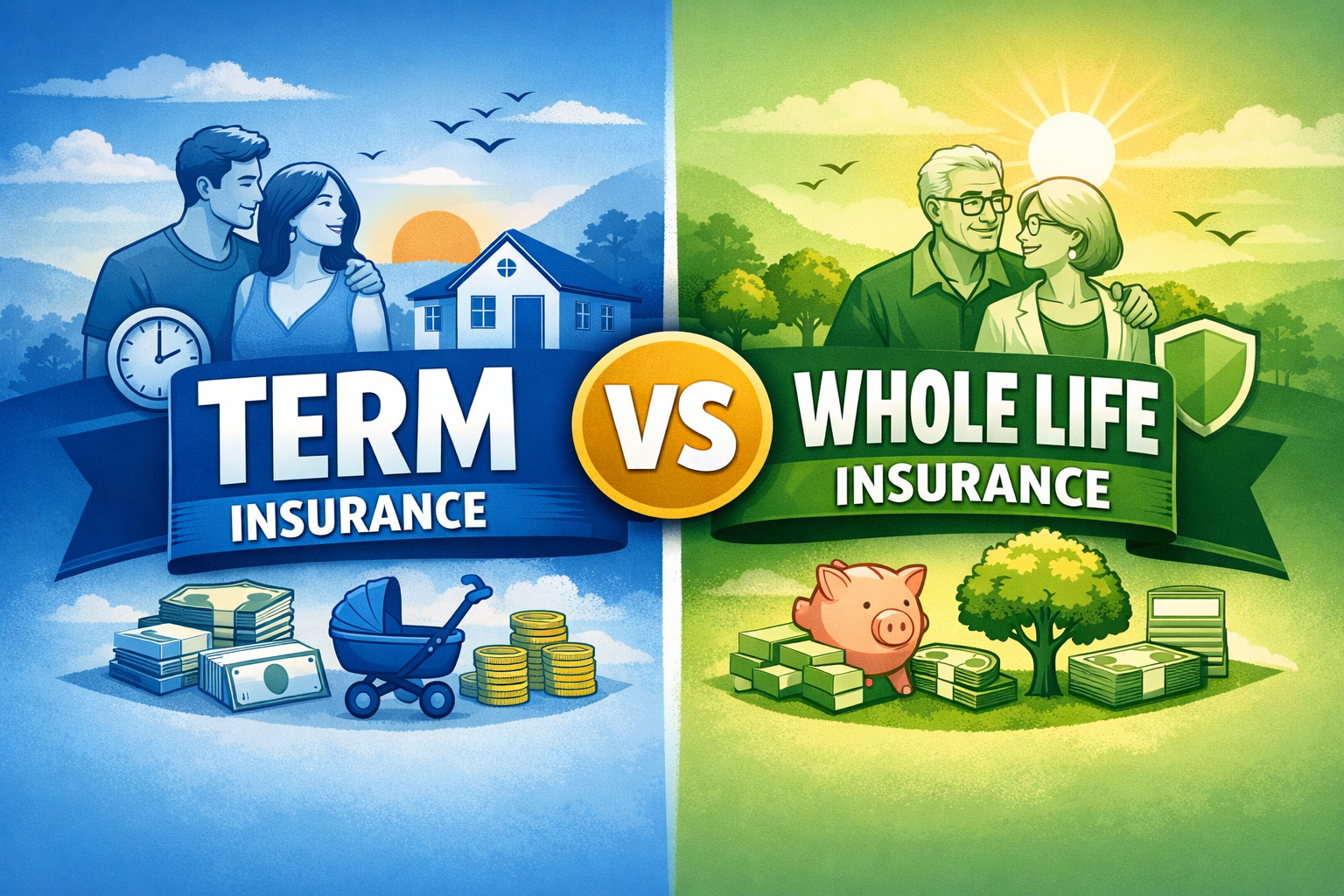
Term vs whole life insurance is mainly a comparison between temporary protection and permanent protection. Term life generally provides a death benefit for a defined period and usually has a lower initial premium for the same benefit amount. Whole life is designed to remain in force for life when required premiums are paid and contract conditions are met, and it includes cash value.
Neither policy is automatically better. Term often fits large obligations with an expected end date, such as income replacement during working years or a mortgage. Whole life may fit needs that do not end, such as final expenses, a lifelong legacy goal, or certain dependent and estate-planning objectives. Some households use both so each policy has one clear job.
The quote button opens LifeLink, a separate third-party website. A quote or application does not guarantee eligibility, approval, pricing, or active coverage.
The differences that matter
Use this table as a starting point, not a substitute for the policy. Whole-life designs can differ, and term contracts do not all have the same duration, conversion privilege, or renewal schedule. The issued contract determines the actual guarantees and limitations.
| Decision point | Term life insurance | Whole life insurance |
|---|---|---|
| Coverage duration | A defined term or stated age, with any renewal governed by the contract. | Designed for lifetime coverage when required premiums are paid and policy terms are satisfied. |
| Primary use | Income, mortgage, dependent years, debt, or another need with an expected end date. | Final expenses, lifelong dependent support, legacy goals, or another permanent need. |
| Initial premium | Usually lower than whole life for the same benefit amount, age, and underwriting profile. | Usually higher because coverage is intended to last for life and includes cash value. |
| Cash value | Traditional term life generally has no cash value. | Includes contractual cash values; cash surrender value may differ and can be lower in early years. |
| Premium pattern | Often level during a guaranteed period; renewal premiums may rise afterward. | Traditional level-premium whole life generally uses scheduled premiums; limited-pay and other designs differ. |
| Flexibility | Some policies permit renewal or conversion within stated deadlines and limits. | May offer loans, withdrawals, nonforfeiture options, dividends on participating policies, or paid-up additions, subject to terms. |
| Main risk to manage | The financial need may outlast the term, and replacement later may cost more or be unavailable. | The higher long-term premium may become difficult to maintain, and policy loans can affect values and benefits. |
If the obligation ends when children become independent, a mortgage is paid, or retirement begins, term may align cleanly with the timeline.
If the need will exist whenever death occurs, a permanent design may be more appropriate—provided the premium fits for the long term.
The intended policy only works if it stays in force. A manageable structure is more useful than an ambitious design that strains the budget.
Temporary protection
Term life covers the insured during a stated period. If the insured dies while the policy is active and the claim is payable under the contract, the named beneficiary receives the death benefit. Traditional term coverage usually does not accumulate cash value, which is one reason it can provide a comparatively large death benefit for a lower initial premium.
The answer depends on the policy. Coverage may end, continue through annual renewal at a higher scheduled premium, or remain eligible for conversion to a permanent product if the conversion period is still open. Renewal without new health evidence can preserve coverage, but the premium may increase substantially. Conversion may preserve insurability, but the new permanent-policy premium is generally based on the insured’s age at conversion and the products allowed by the carrier.
Do not assume every term policy is convertible or renewable. Verify the conversion deadline, maximum conversion age, eligible products, partial-conversion rules, renewal schedule, and final coverage age before buying.
If the insured outlives the coverage period, traditional term life generally does not return premiums or pay a maturity benefit. A new policy later may require fresh underwriting, and age or health changes can make replacement more expensive or unavailable. Return-of-premium term may exist for eligible applicants, but it is a different design with its own conditions and typically a higher premium than traditional term.
For a deeper look at timelines, renewal, and conversion, see the term life insurance guide.
Permanent protection
Whole life is a type of permanent life insurance. Traditional whole life is designed to provide a death benefit for the insured’s lifetime when scheduled premiums are paid and contract requirements are met. It also contains contractual cash values that generally build according to a schedule in the policy.
The words “whole life” do not describe one identical product. Policies may be participating or nonparticipating, ordinary-pay, limited-pay, single-premium, or designed in another approved form. Premium schedules, cash values, dividends, nonforfeiture options, riders, and underwriting rules vary. Review the actual illustration and contract rather than relying on a generic description.
A participating whole-life policy may pay dividends based on the insurer’s experience and the policy’s terms. Dividends are not guaranteed. If paid, the owner may have options such as taking cash, reducing premiums, accumulating dividends with the insurer, or buying paid-up additions. Available options vary.
A nonparticipating policy does not pay policyholder dividends. Its premium, benefit, and cash-value guarantees are established by the contract. Neither structure should be selected from a sales illustration alone. Ask which values are guaranteed, which are not, and what happens under lower non-guaranteed assumptions.
Understand the policy mechanics
Cash value is a policy value that develops according to the contract. Cash surrender value is the amount available if the owner ends the policy, after any applicable surrender provisions, loans, interest, or other adjustments. These amounts may not be identical, and early surrender values can be significantly lower than premiums paid.
| Item | What it generally means | What to verify |
|---|---|---|
| Guaranteed cash value | Contractual value shown for stated policy years when requirements are met. | The guaranteed schedule and assumptions required for those values. |
| Cash surrender value | Net amount available upon surrender after applicable adjustments. | Early-year values, surrender provisions, outstanding loans, and tax considerations. |
| Dividend | A non-guaranteed payment that may be declared on a participating policy. | Which illustration values assume dividends and what happens if dividends are lower. |
| Policy loan | A loan secured by policy value that accrues interest under the contract. | Loan rate, direct or recognition method if relevant, repayment, and effect on benefits and lapse risk. |
| Withdrawal or partial surrender | A transaction that removes value from the policy when permitted. | Effect on cash value, death benefit, guarantees, future premiums, and taxation. |
| Nonforfeiture option | A contractual choice that may preserve some value if premium payments stop. | Available reduced paid-up, extended-term, surrender, or other options and their consequences. |
A policy loan accrues interest. An unpaid loan and interest generally reduce policy values and the death benefit. If a policy lapses or is surrendered with a gain and an outstanding loan, taxable income may result. The exact outcome depends on the contract and tax circumstances. Owners should request an in-force illustration before a material loan or change and consult a qualified tax professional when needed.
Under many whole-life designs, cash value supports the policy and is not automatically added on top of the stated death benefit at death. Outstanding loans and interest can reduce what beneficiaries receive. Some policies may be structured differently, so the contract’s death-benefit provision controls.
Compare guaranteed and non-guaranteed columns separately. A life-insurance illustration is not a promise that future dividends or projected values will occur. Ask to see how the policy performs using guaranteed values alone and under less favorable non-guaranteed assumptions.
Price must be tied to purpose
Whole life generally requires a higher premium than term for the same death benefit because it is designed for lifetime protection and includes cash-value guarantees. Term covers a limited period and typically has no cash value. That structural difference—not a judgment that one policy is better—drives much of the premium gap.
Both types are affected by age, medical history, medications, build, nicotine classification, family history, and other underwriting evidence. Product eligibility also varies.
A larger benefit costs more. For term, a longer guaranteed period generally costs more than a shorter one. Whole life prices a permanent commitment rather than a limited term.
Monthly, annual, ordinary-pay, limited-pay, and single-premium designs are not interchangeable. Confirm how long premiums are required and which amounts are guaranteed.
Waiver, child, spouse, accidental-death, guaranteed-insurability, and accelerated-benefit features may change cost and coverage. Definitions and availability vary.
Higher-risk work, aviation, travel, driving history, and hazardous hobbies can affect underwriting, exclusions, pricing, or product availability.
Participating status, paid-up additions, limited-pay schedules, return-of-premium term, and other features can create materially different premiums and outcomes.
Do not compare a large term benefit with a much smaller whole-life benefit and conclude that price alone proves value. First identify the temporary and permanent needs. Then compare policies doing the same job: same insured, benefit, underwriting class, payment mode, riders, and guaranteed period.
For whole life, examine guaranteed premiums, guaranteed death benefits, guaranteed cash values, and cash surrender values by year. Review non-guaranteed dividends separately. For term, examine the level-premium period, renewal schedule, conversion conditions, and coverage end date. A policy that appears inexpensive can still be a poor fit if it expires before the need or depends on projections the owner misunderstood.
Turn the comparison into a decision
Start by separating obligations into two columns: needs expected to end and needs expected to remain for life. This prevents a small permanent policy from being asked to replace decades of income, or a temporary policy from being used for an obligation that will still exist after the term expires.
| Planning need | Possible starting point | Why | Question to resolve |
|---|---|---|---|
| Income during working years | Term life | The need may fall as retirement assets grow and dependents become independent. | How many years and how much annual support would survivors need? |
| Mortgage or dependent years | Term life | The term can be aligned with the expected payoff or dependency timeline. | Should the benefit pay off the balance or fund payments and flexibility? |
| Final expenses or permanent legacy | Whole life or another permanent design | The need exists whenever death occurs. | What guaranteed benefit is required, and is the premium sustainable? |
| Lifelong dependent support | Permanent coverage coordinated with legal planning | The support need may continue after the insured’s working years. | How should ownership and beneficiary arrangements interact with public benefits and trusts? |
| Large temporary need plus smaller lifelong need | Blend of term and permanent coverage | Each layer can be sized for a different job and timeline. | Which amount should decline later, and which benefit must remain? |
A family may need substantial income protection while children are young and a mortgage remains, plus a smaller benefit intended to remain for final expenses. A large term policy can address the temporary exposure while a smaller whole-life policy addresses the lifelong need. This is a planning concept, not a recommendation for every household; affordability, underwriting, policy terms, and existing resources still determine suitability.
Use the life insurance hub for a broader policy overview or begin with the online life insurance quote guide to understand the difference between an estimate, application, underwriting offer, and issued policy.
Avoid the common comparison traps
Temporary and permanent obligations often call for different amounts and durations. Separate them before choosing a product.
Whole-life dividends and illustrated non-guaranteed values may change. Base essential decisions on contractual guarantees.
A low term premium can hide an inadequate duration. Check the need horizon, renewal schedule, conversion deadline, and final age.
Policy loans accrue interest and can reduce values and benefits, increase lapse risk, and create tax consequences in some situations.
A small lifelong benefit may not replace meaningful income. Calculate the household need before choosing the policy type.
Do not cancel an existing policy until new coverage is approved, issued, accepted, paid, and confirmed in force.
Straight answers to the big questions
Not universally. Term often fits large needs with an end date and generally has a lower initial premium for the same benefit. Whole life may fit a permanent need and includes cash value, but it usually requires a higher long-term premium. The better choice is the sustainable structure that matches the purpose.
The level term ends according to the contract. Coverage may terminate, become annually renewable at higher scheduled premiums, or remain convertible if the deadline has not passed. Traditional term generally does not pay a benefit merely because the insured outlives the term.
Whole life is designed for lifetime coverage, but the policy must be maintained according to its terms. Required premiums, loans, withdrawals, automatic premium loans, changes, and other transactions can affect values and coverage. Review guarantees and request an in-force illustration when making material changes.
Some term policies allow conversion to an eligible permanent policy without new medical underwriting during a stated window. The available product may or may not be whole life. Deadlines, ages, benefit limits, partial conversions, and product choices vary, and the new premium generally reflects age at conversion.
Often, no. Under many designs, beneficiaries receive the policy’s payable death benefit, reduced by outstanding loans and interest, rather than the death benefit plus a separate cash-value payment. Some contracts differ, so review the death-benefit provision.
No. Participating whole-life policies may pay dividends, but dividends are not guaranteed. Review guaranteed values separately from illustrated dividends and understand how lower dividends would affect premiums, paid-up additions, cash value, and the death benefit.
Yes, when the household has both temporary and permanent needs. Term can address a larger time-limited exposure, while a smaller whole-life policy addresses a lifelong goal. The combined premium must remain affordable, and each policy should have a clearly defined purpose.
Define the coverage amount, separate temporary from permanent obligations, set a sustainable premium, and then compare actual guarantees, limitations, underwriting requirements, and contract features.
You will continue to the LifeLink third-party website. Coverage is not effective unless an insurer approves and issues the policy and all applicable requirements are satisfied.




