✔ Licensed Insurance Agents★ Access to A-Rated & A+ Rated Insurance Companies🔒 Secure & Private Online Quotes✓ No Spam✓ We Never Sell Your Personal Information
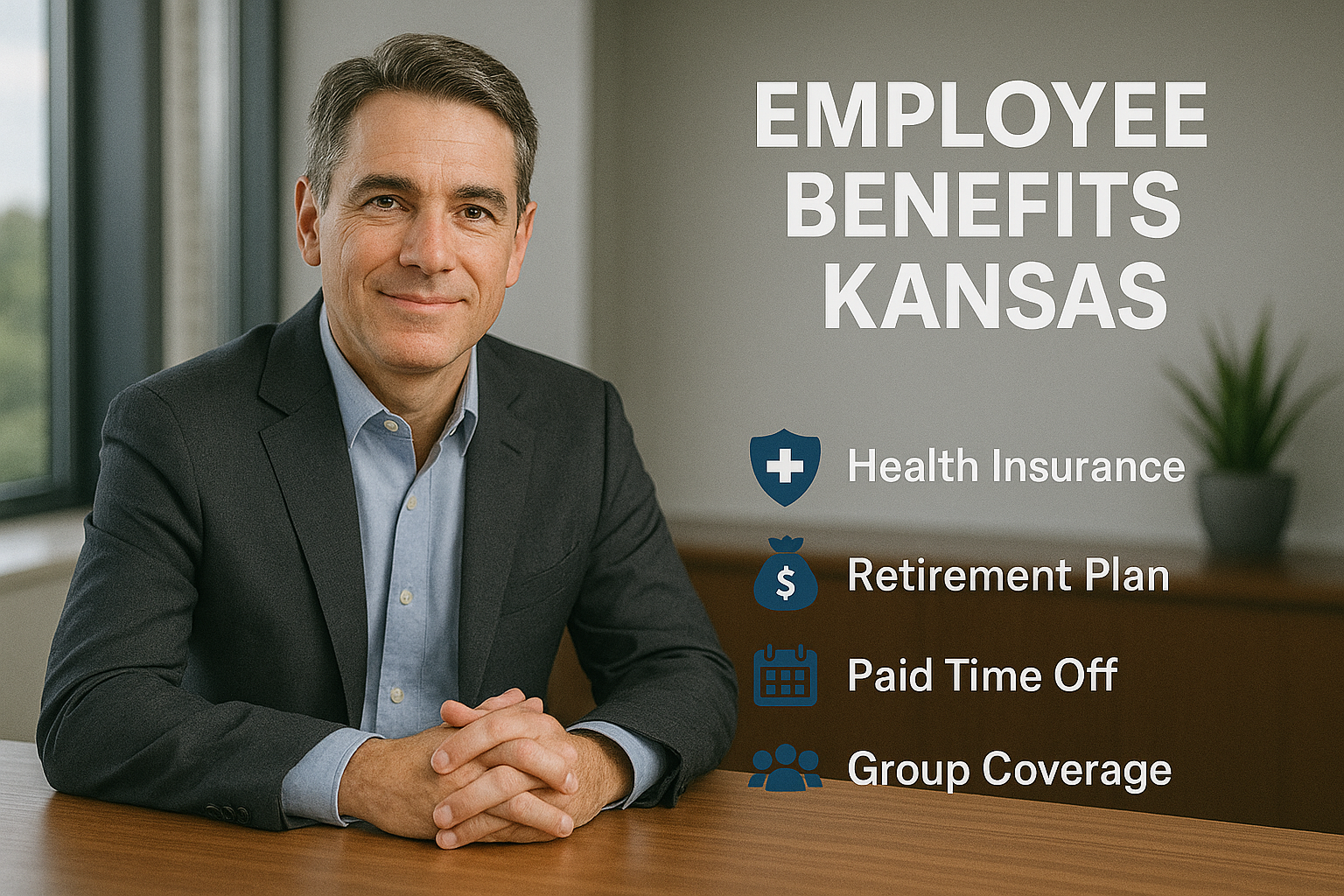
Build a Kansas employee benefits package that employees actually use—without losing sight of budget, compliance, or admin workload.
Blake Insurance Group helps Kansas employers design group medical, dental, vision, life/AD&D,
short- and long-term disability, and tax-advantaged accounts (HSA, FSA, HRA, ICHRA, QSEHRA)
around your workforce and risk tolerance. We align with small-group 1–50 market rules, Kansas continuation requirements, and the evolving
telehealth landscape, then stay with you through onboarding, payroll deductions, and renewals. If you’re searching “near me,” our team supports
the Kansas metros listed below with local and virtual help.
Kansas follows federal Affordable Care Act small-group standards but also has its own definition of “small employer” and state continuation
requirements. This table gives a fast snapshot before we dive into plan design and funding.
Topic
What to know
Small employer definition
For Kansas market rules, “small employer” generally means 2–50 employees on at least half of the working days in the prior year.
For federal ACA purposes, employers with 1–50 FTEs are typically treated as small group.
Who must offer coverage?
Employers with 50 or more FTEs may face federal employer-mandate penalties if they don’t offer affordable, minimum-value
coverage. Smaller Kansas employers usually are not required to offer a group plan, but many do to stay competitive.
Waiting period limit
Group health plans and insurers may not impose a waiting period longer than 90 days from the date an employee meets eligibility
rules. Many Kansas groups target first-of-month following 30 or 60 days of employment.
Kansas continuation (mini-COBRA)
For employees not eligible for federal COBRA (often under 20 employees), Kansas law generally allows up to 18 months of continued
insured group medical coverage when election and premiums are handled correctly.
Telehealth rules
Insured plans in Kansas must cover many medically necessary services delivered via telemedicine similarly to in-person visits
(coverage parity). Universal payment parity with in-person rates is not guaranteed and can vary by payer and plan.
Funding & HRA choices
Employers can choose fully-insured, level-funded/ASO, or reimbursement models like
ICHRA (any size) and QSEHRA (generally <50 FTEs that do not offer a group plan), depending
on size, risk profile, and preference.
Effective dates
Most Kansas group plans begin on the first of any month. We’ll coordinate open enrollment, binder payments, and
carrier requirements so your start date matches payroll and HR workflows.
Notes: State insurance mandates apply primarily to insured plans. Self-funded ERISA plans follow federal rules and the plan document, even
when Kansas statutes are more detailed.
Plan & funding options at a glance
Your benefits strategy should balance predictability, flexibility, and long-term cost control. We model multiple paths side-by-side—looking at
year-one and multi-year projections, not just this month’s premium.
Option
How it works
Best for
What to consider
Fully-insured (HMO/EPO/PPO/HDHP)
Carrier assumes claims risk in exchange for a predictable monthly premium.
Plan types include HMO/EPO/PPO and high-deductible health plans (HDHPs) that can pair with HSAs.
Employers wanting simplicity, predictable budgeting, and strong networks without deep claims analytics.
Less transparency into claims drivers; renewal increases are based on pooled and group-level experience. Design and network choice still matter.
Level-funded / ASO
Employer funds claims up to a capped amount with stop-loss protection. If claims are lower than expected, there may be a surplus
to share or retain, depending on the contract.
Groups with reasonably stable risk, solid participation, and interest in claims data and potential long-term savings.
Requires comfort with variable costs and more engagement with compliance, reporting, and plan governance.
ICHRA
An Individual Coverage HRA lets you set tax-free monthly allowances by employee class. Employees buy their own individual
health plans that meet minimum requirements and get reimbursed up to the allowance.
Multi-location or remote teams, employers with varied wage levels or hiring patterns, and groups outgrowing traditional small-group options.
Member experience depends on the local individual market and guidance provided. Class design and communication are critical to avoid confusion.
QSEHRA
A Qualified Small Employer HRA is available to certain employers with fewer than 50 FTEs that do not offer a group plan.
You reimburse premiums and eligible expenses up to IRS-set annual caps.
Very small Kansas employers who want to help with costs but keep administration light and predictable.
Coordination with premium tax credits, minimum essential coverage rules, and the fact that you cannot also offer a traditional group medical plan.
We’ll help you choose the right mix—sometimes that means a traditional fully-insured plan; in other cases, an ICHRA or level-funded arrangement
is the better long-term fit.
Common benefits & add-ons for Kansas employers
Medical & virtual care
Core medical plans can be structured around HMO, EPO, or PPO networks with copay or coinsurance-driven designs. HDHP/HSA combinations give
employees tax-favored savings while keeping premiums in check. Telehealth, virtual primary care, digital behavioral health, and 24/7 nurse
lines now play a central role in cost management and access.
Dental & vision
Dental PPO or DHMO options can include preventive-first designs, ortho riders, and enhanced major services. Vision plans typically cover exams,
lenses, frames, and contacts with preferred-provider discounts. Bundling medical, dental, and vision can simplify billing and sometimes unlock
multi-line discounts.
Life/AD&D & disability income
Employer-paid basic life and AD&D, paired with voluntary buy-up coverage, helps families manage worst-case scenarios. Short-term disability (STD)
protects paychecks during shorter absences; long-term disability (LTD) supports employees in extended disability situations.
We review pre-existing condition clauses, elimination periods, and portability/conversion options.
Accounts, HRAs & reimbursements
Tax-advantaged accounts—HSA, FSA, limited-purpose FSA, HRA, ICHRA,
and QSEHRA—let you fine-tune affordability and flexibility. We help you decide when to keep everything under one carrier vs.
when a stand-alone HRA or reimbursement strategy makes more sense for your Kansas group.
Premiums are only one part of the story. Network choice, plan design, participation, and how you structure employer vs. employee contributions all
shape the true cost of your Kansas benefits strategy.
Driver
What influences cost
How we help you save
Funding model
Fully-insured, level-funded, and ICHRA/QSEHRA options all push cost and risk in different directions. Assumptions about claims, stop-loss,
and administrative fees matter.
We quote multiple models side-by-side and stress-test them so you see worst-case, expected, and best-case cost ranges before you commit.
Network & plan design
Narrow networks, tiered networks, HDHPs, and copay-based designs shift who pays what, when. Provider availability across Wichita,
Kansas City KS, and regional areas must be mapped in advance.
We match employees and dependents to key hospitals and clinics before recommending networks, helping you avoid surprise out-of-network issues.
Participation & eligibility
Carriers require minimum participation after valid waivers. High declination rates can drive up rates, restrict options, or block certain funding
arrangements.
We use employer-paid “base” benefits plus voluntary buy-ups, clear eligibility rules, and proactive communication to lift participation.
Contribution strategy
Percentage vs. flat-dollar employer contributions, dependent contributions, and composite vs. age-banded rating all affect perceived fairness
and plan affordability.
We design simple but defensible contribution formulas, then model their impact on both your budget and employee take-home pay.
Virtual care & navigation
Telehealth, care navigation, second-opinion programs, and disease-management tools influence long-term claims and employee satisfaction.
We prioritize first-call virtual and nurse-line options where appropriate and help you promote them so they are used—not just offered.
Every Kansas carrier sets detailed rules for eligibility, participation, and enrollment. We verify those rules upfront so you are not surprised
mid-implementation or at renewal.
Topic
Typical rule
What we verify
Pro tip
Employer size
2–50 employees are usually treated as small group for Kansas-specific rules; 51+ falls under large-group approaches.
ACA employer-mandate rules hinge on full-time equivalent counts.
Common-law employees, controlled-group status, seasonal or variable-hour workers, and any affiliated entities that could change counts.
Keep payroll and ownership records organized—underwriting goes faster and you get cleaner offers from carriers.
Waiting period
Cannot exceed 90 days from eligibility. Many employers in Kansas choose first-of-month following 30 or 60 days.
Orientation periods, measurement/stability periods for variable-hour staff, and the impact of your hire dates on when coverage can start.
Time eligibility so new hires experience a smooth transition from prior coverage, reducing gaps and frustration.
Participation
Carriers require minimum enrolled employees after valid waivers (such as Medicare or other group coverage) to keep the plan viable.
Eligible vs. ineligible classes, probationary periods, and how you document waivers for compliance and audits.
Offer a clear, employer-paid base benefit with optional buy-up tiers—employees appreciate choice, carriers appreciate healthy participation.
Continuation (COBRA vs. state)
Federal COBRA generally applies at 20+ employees (usually 18–36 months by qualifying event). For those not eligible
for COBRA, Kansas continuation law commonly allows up to 18 months of coverage on insured plans.
Which law applies to your group, when notices must be sent, who collects premiums, and how to handle off-boarding consistently.
Maintain a simple off-boarding checklist so continuation rights are explained the same way every time.
Effective dates & renewals
Most plans start on the first of the month, with year-round effective dates available. Renewals often occur annually on the plan anniversary.
Binder requirements, enrollment windows, and coordination across medical, dental, vision, life/AD&D, and disability lines.
Align major lines of coverage on the same renewal month to keep communication, budgeting, and benchmarking simpler.
Kansas service areas we support
Kansas metros & corridors
We work with employers across Kansas, including:
Wichita, Derby, Andover, Hutchinson
Kansas City KS, Overland Park, Olathe, Lenexa, Shawnee
Topeka, Lawrence, Manhattan, Junction City
Salina, Garden City, Dodge City, Hays and surrounding communities
Whether your team is concentrated in one metro or spread across multiple locations, we’ll map networks and funding options to actual employee ZIP codes.
What to have ready for a group quote
Employee census (names or IDs, ZIP codes, dates of birth, coverage tier, eligibility status)
Current plan summaries (if any), renewal offers, and contribution formulas
Preferred launch date and any non-negotiables (key providers, required benefits, or budget targets)
Upload these once through our secure census form and we will handle carrier conversations, plan comparisons, and implementation timelines.
Kansas employee benefits — FAQs
How does Kansas define a small employer for group medical?
For market rules in Kansas, small employers are generally those with 2–50 employees on at least half of their working days in
the prior year. From a federal ACA perspective, employers with 1–50 full-time equivalent employees are usually treated as
small group, but carriers may require at least two common-law employees enrolled on day one.
Are small employers in Kansas required to offer health insurance?
Employers with fewer than 50 full-time equivalent employees are typically not required under federal law to offer coverage, and Kansas
does not add a separate mandate. However, many small employers choose to offer benefits to compete for talent and improve retention.
What are the Kansas continuation rules vs. federal COBRA?
COBRA generally applies to employers with 20 or more employees and can provide 18–36 months of continuation coverage depending
on the qualifying event. For employees not eligible for COBRA, Kansas continuation law usually allows up to 18 months of
continued insured group coverage when election and premium requirements are met.
Is telehealth covered and reimbursed the same as in-person visits?
Insured plans in Kansas must cover many services when delivered via telemedicine if those services are covered in-person, which is known as
coverage parity. However, there is no universal payment parity requirement, so reimbursement rates for
telehealth vs. in-person visits can differ by plan.
Should we look at ICHRA or QSEHRA instead of a traditional group plan?
For some Kansas employers, yes. ICHRA is available to employers of all sizes and can work well for multi-location teams or
those wanting more defined budgets. QSEHRA is limited to certain employers with fewer than 50 FTEs that do not offer a group
plan. We routinely model ICHRA and QSEHRA alongside fully-insured and level-funded options so you can see which structure fits best.
Disclosure
Independent agency: Blake Insurance Group LLC is an independent insurance agency. We compare multiple carriers and funding
approaches to help Kansas employers design benefits that fit their workforce and budget.
Brand ownership: All product and brand names are trademarks or registered trademarks of their respective owners. Plan availability,
networks, benefits, and eligibility vary by carrier and by state, and may change over time.
Licensing: Blake Insurance Group LLC is a licensed insurance producer (NPN 16944666). Employer responsibility for compliance with
federal and state laws, including ERISA, COBRA, state continuation, and tax rules, ultimately rests with the employer; we recommend you also consult
with legal and tax advisors.
employee benefits kansas 2026, kansas small group health insurance 2–50 employees, kansas mini cobra 18 month continuation, kansas telehealth coverage parity no payment parity, ichra kansas employers, qsehra kansas rules fewer than 50 ftes, level funded health plans kansas, kansas group medical dental vision life std ltd, employee benefits broker near me wichita kansas city ks overland park olathe topeka lawrence salina hutchinson garden city, kansas group benefits cost control strategies, kansas employer contribution strategy for health insurance