Medicare Advantage bundles
A private Medicare plan administers Part A and Part B and usually includes Part D. It may use networks, referrals, prior authorization and plan-specific cost sharing.
Two Medicare coverage paths • 2027 planning guide
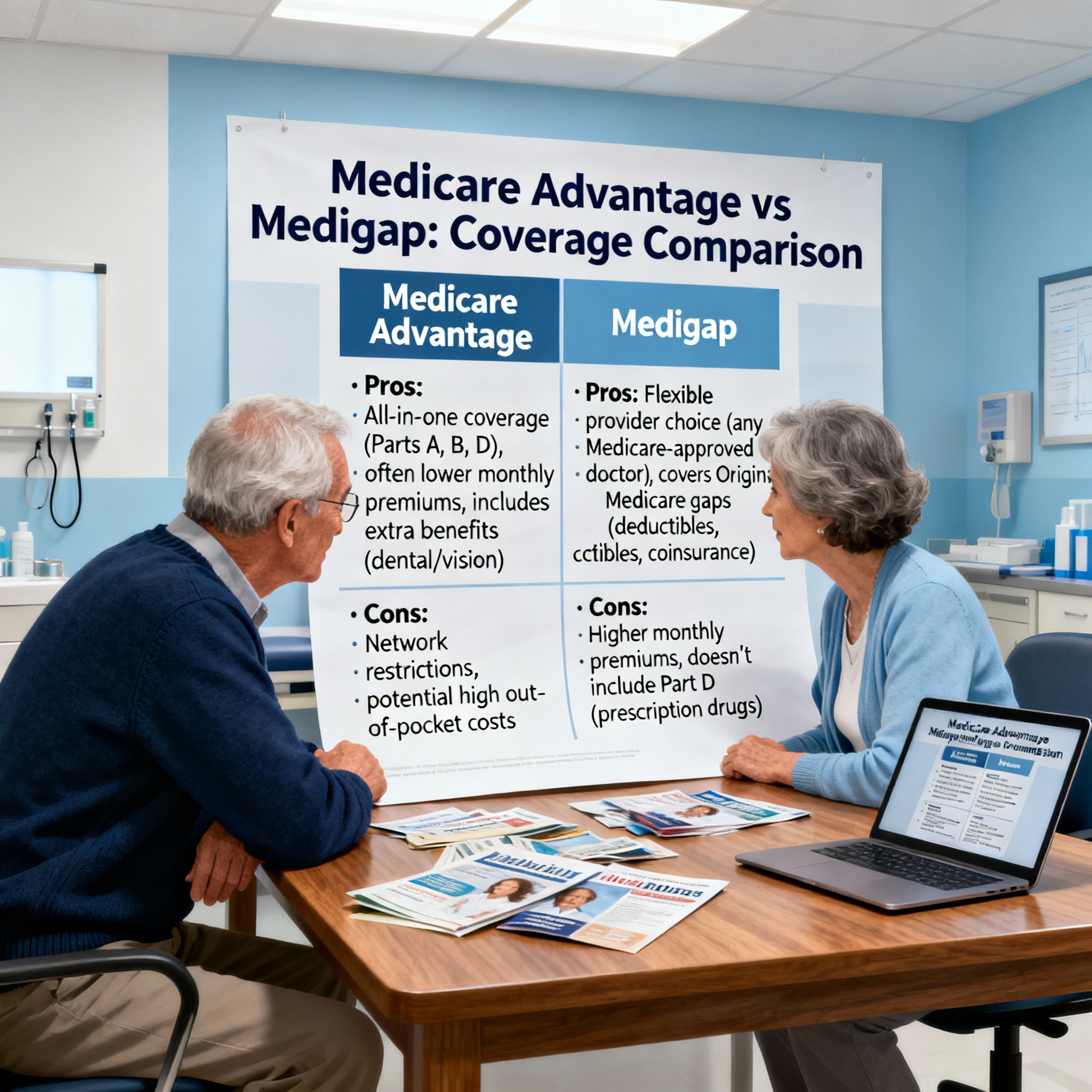
Medicare Advantage vs. Medigap compares two different ways to organize Medicare coverage. Medicare Advantage is a private Medicare-approved alternative for receiving Part A and Part B benefits, often with Part D prescription coverage included. Medigap is supplemental insurance that works only with Original Medicare and helps pay specified Part A and Part B cost sharing. It does not replace Original Medicare.
The two structures cannot be used together. A Medigap policy cannot pay a Medicare Advantage plan’s deductibles, copayments or coinsurance, and it is illegal for someone to sell a Medigap policy to a person who remains enrolled in Medicare Advantage except when that Advantage coverage will end before the Medigap policy starts. A complete comparison therefore evaluates Medicare Advantage against Original Medicare plus Medigap and, when drug coverage is wanted, a separate Part D plan.
If you searched for Medicare comparison help “near me,” begin with the permanent address, Medicare effective dates, current coverage, doctors, hospitals, prescriptions, pharmacies, travel patterns and expected care. Those facts are more useful than choosing from premium, brand recognition or supplemental benefits alone.
2027 planning status: This page was substantively reviewed on August 24, 2026. Medicare says information for the following year’s plans becomes available beginning in October. Until final 2027 plan materials are released, current premiums, benefits, networks, formularies, service areas and star ratings must not be treated as final 2027 information.
The Wellcare pathway is carrier-specific and displays current Medicare Advantage information; it does not offer Medigap, compare every carrier or present final 2027 plan data. The Blake Insurance Group form requests assistance and does not enroll you in Medicare or an insurance plan.
The Medicare Advantage side includes the Part B premium, the exact private plan, its provider rules, Part A and Part B cost sharing, its medical out-of-pocket limit and its drug benefit when included. The Medigap side includes Original Medicare, a Medigap policy, a stand-alone Part D plan when prescription coverage is wanted, and any separate dental, vision or hearing coverage the person chooses.
Neither pathway is automatically better. The useful question is which complete arrangement fits the person’s provider access, prescriptions, travel, budget, tolerance for network and authorization rules, and ability to absorb costs during a high-use year. Eligibility and enrollment timing must also work before a preference can become an available choice.
Quick facts
A private Medicare plan administers Part A and Part B and usually includes Part D. It may use networks, referrals, prior authorization and plan-specific cost sharing.
Original Medicare remains primary. A private Medigap policy pays specified Original Medicare cost sharing according to its standardized benefits and policy terms.
Medigap policies sold today do not include prescription coverage. Someone who wants outpatient drug coverage generally adds a separate Part D plan.
This table compares the usual structure of each pathway. Exact Medicare Advantage rules vary by plan. Medigap availability, premiums, underwriting and state protections depend on the applicant’s location and enrollment circumstances.
| Comparison area | Medicare Advantage | Original Medicare plus Medigap |
|---|---|---|
| How Part A and Part B work | The private plan administers Medicare-covered services under Medicare rules and the plan’s Evidence of Coverage. | Original Medicare pays first for covered services; the Medigap policy then pays eligible amounts under its benefits. |
| Provider access | Many plans use provider networks. HMO, PPO and other plan types have different out-of-network rules. | A beneficiary can generally use any U.S. doctor or hospital that accepts Medicare. Most Medigap policies do not create a medical network. |
| Referrals and authorization | Referrals or prior authorization may apply depending on the plan and service. | Original Medicare usually does not require referrals and generally uses fewer prior-authorization rules, although specific programs and services can differ. |
| Prescription drugs | Most plans include Part D. The exact formulary, pharmacy network and restrictions must be reviewed. | Medigap policies sold after 2005 do not include Part D. A separate drug plan is generally used when outpatient prescription coverage is wanted. |
| Medical cost protection | The plan has a yearly limit on member spending for covered Medicare Part A and Part B services, subject to its rules. | Original Medicare has no annual medical out-of-pocket limit by itself; Medigap reduces specified deductibles, copayments or coinsurance according to the policy. |
| Premium arrangement | The member keeps paying the Part B premium and may owe a plan premium plus cost sharing. | The member keeps paying the Part B premium and separately pays the Medigap premium and any Part D premium. |
| Supplemental benefits | Some plans offer dental, vision, hearing, fitness, transportation or other benefits under plan-specific limits. | Medigap generally does not cover routine dental, vision, hearing aids, long-term care or private-duty nursing. Separate coverage may be needed. |
| Local availability | The plan must serve the permanent residential service area and accept enrollment during a valid election period. | Policy availability, premiums, eligibility and underwriting depend on federal protections, state law, the insurer and the application timing. |
| Annual review | Benefits, costs, network, formulary and rules may change each plan year; review the Annual Notice of Change. | Standardized Medigap benefits generally remain the same while premiums can change; the separate Part D plan should be reviewed annually. |
| Controlling documents | Summary of Benefits, Evidence of Coverage, provider directory, formulary, pharmacy directory and enrollment confirmation. | Original Medicare rules, the Medigap outline and policy, insurer acceptance, and the separate Part D plan documents. |
Neither column is a complete cost estimate by itself. Medicare Advantage drug spending, premiums and non-covered services may sit outside the medical limit. On the Medigap side, the premium continues whether care is used or not, and the separate Part D plan has its own costs and rules.
Coverage and access
Provider access is often the clearest structural difference. Medicare Advantage availability begins with the permanent residential service area, then depends on the exact plan’s network and rules. Original Medicare is national: a beneficiary can generally use any U.S. provider that accepts Medicare. A standard Medigap policy follows Original Medicare’s covered claim rather than replacing its provider rules.
There are important exceptions and details. Medicare SELECT is a type of Medigap policy that can require hospitals and, in some cases, doctors within a network for full benefits except in emergencies. A Medicare Advantage PPO may allow covered out-of-network care at a higher cost, while an HMO may have narrower non-emergency options. Always verify the exact policy or plan rather than relying only on its category.
The comparison should follow the person’s real care route from the primary doctor through specialists, testing, hospital services, therapy, rehabilitation, home health and equipment suppliers.
| Care situation | Medicare Advantage review | Original Medicare plus Medigap review |
|---|---|---|
| Regular doctors | Confirm every clinician and practice address under the complete plan and network name. | Confirm that each provider accepts Medicare; a standard Medigap policy usually follows the eligible Original Medicare claim. |
| Hospital and facility care | Check the exact hospital campus, outpatient center, laboratory, imaging site and rehabilitation facility. | Confirm Medicare participation and whether the Medigap benefit covers the remaining eligible cost share. |
| Specialists and referrals | Determine whether referrals, designated medical groups or prior authorization apply. | Original Medicare generally does not require a referral, but the provider must accept the patient and Medicare. |
| Planned procedures | Verify the surgeon, facility, anesthesia, pathology, rehabilitation and authorization requirements separately. | Verify Medicare coverage and participating providers, then check what the Medigap policy pays for the eligible claim. |
| Equipment and home services | Use network durable medical equipment, home health and therapy suppliers when the plan requires them. | Use Medicare-approved suppliers and confirm assignment, coverage criteria and the Medigap cost-sharing benefit. |
| Domestic travel | Emergency and urgently needed care is covered, but routine out-of-area care depends on the plan type and rules. | Original Medicare generally works with Medicare-accepting providers throughout the United States. |
| Foreign travel | Coverage outside the United States is limited; some plans may offer an extra emergency or urgent benefit. | Original Medicare generally has limited foreign coverage; some standardized Medigap plans include a limited foreign-travel emergency benefit. |
| Provider changes | Networks can change, so current members should review directories and notices each year. | A standard Medigap policy is not usually tied to a provider network, but Medicare participation and policy terms still matter. |
For Medicare Advantage, ask whether the clinician and location participate in the complete plan and network—not merely whether the office accepts Medicare or the carrier. For Original Medicare plus Medigap, ask whether the provider accepts Medicare and, when relevant, accepts assignment. Then confirm how the Medigap policy handles the eligible cost share.
Save the date of each check and any confirmation number. Directories and contracts can change, and a health-system name does not prove every affiliated physician, campus or service is included. A complete review names the location that will actually provide care.
Total-cost and prescription review
A low or zero Medicare Advantage premium does not mean health care is free, and a higher Medigap premium does not automatically make that path more expensive overall. The meaningful comparison adds every recurring premium to expected medical cost sharing, prescription spending and expenses the arrangement does not cover. It also tests a higher-use year rather than assuming care will remain routine.
Build two scenarios for both paths. The routine scenario can include primary care, specialists, laboratory work, imaging, therapy, equipment and prescriptions. The higher-use scenario can add an inpatient stay, outpatient procedure, emergency care, rehabilitation or frequent specialist services. The purpose is to locate risk—not predict illness.
Add the Part B premium, any plan premium, medical deductibles and cost sharing, prescription costs and the exposure up to the medical out-of-pocket limit.
Add the Part B premium, Medigap premium, medical amounts the policy does not pay, and any separate Part D premium and drug costs.
Account separately for dental, vision, hearing, long-term care, non-covered services, foreign care and any benefit limits that apply.
Drug coverage cannot be judged by asking only whether a medicine appears on a formulary. Record the drug name, strength, dosage form and refill frequency. Then check its tier, restrictions and expected cost at the exact retail or mail-order pharmacy. A chain pharmacy may be preferred at one location or plan and standard at another, and the same drug can be treated differently among plans.
Most Medicare Advantage plans include Part D, and in most Medicare Advantage HMOs and PPOs a member cannot add a stand-alone drug plan. An incompatible Part D enrollment can trigger disenrollment from Medicare Advantage. On the Medigap path, policies sold after 2005 do not include prescription coverage, so a separate Part D plan is generally needed when the person wants outpatient drug protection.
In most states, Medigap policies are standardized by letter. Policies with the same letter provide the same standardized medical benefits even when different companies sell them, but premiums, rating methods, discounts, service and underwriting decisions can differ. Massachusetts, Minnesota and Wisconsin use different standardization systems. Eligibility for certain lettered policies also depends on when the person first became eligible for Medicare.
Standardization does not mean every insurer offers every letter or accepts every application. It also does not turn Medigap into comprehensive medical insurance by itself: Original Medicare remains primary, and the policy pays only according to its defined benefits.
Medicare Advantage may offer dental, vision, hearing, fitness, transportation, over-the-counter or other supplemental benefits. Medigap generally does not. Compare the exact covered items, provider or vendor network, dollar or visit limit, frequency rule, authorization and unused-balance rule. Do not trade away a necessary clinician, prescription or manageable medical cost structure solely for an advertised extra.
Enrollment periods
Being allowed to change how Medicare benefits are received does not automatically guarantee that a Medigap insurer must issue a policy. The Medicare election period, Medigap application right, Part D enrollment and all effective dates must be coordinated before existing coverage ends.
Current members should review the Annual Notice of Change and Evidence of Coverage received in the fall. Check premiums, deductibles, copayments, the medical out-of-pocket limit, provider changes, drug coverage and supplemental-benefit rules. If the plan will not be offered next year, the member should follow the non-renewal notice and verify replacement coverage rather than assuming enrollment continues.
Outside a protected Medigap period, an applicant may face medical underwriting, a higher price or denial where state law permits. Some states provide additional rights, so the state insurance department and insurer rules matter. Do not assume that Annual Open Enrollment guarantees Medigap acceptance.
Before leaving Medicare Advantage, confirm the valid election, written Medigap acceptance and effective date, return to Original Medicare, and any stand-alone Part D effective date. Do not cancel existing coverage based only on a quote or incomplete application.
Decision checklist
Use the same personal profile and care scenarios for both paths. Keep exact plan IDs, policy letters and insurer names attached to notes; broad product labels are not enough. Avoid sending a Medicare number, health history or other sensitive information through public comments or unsecured channels.
Gather the Part A and Part B effective dates, current coverage, state, county, complete ZIP code and planned move date. These facts affect plan availability and Medigap rights.
Record the Medicare election period and the Medigap open-enrollment, guaranteed-issue or state-law right that would support the intended change.
Include the full names and addresses of the primary doctor, specialists, hospital campuses, clinics, laboratories, therapy providers, equipment suppliers and rehabilitation facilities.
List every prescription with strength, dosage form and frequency. Add the exact pharmacies used and whether mail order is acceptable. Include drugs administered in a medical setting because those may follow medical-benefit rules rather than Part D.
Include every premium, medical deductible, copayment, coinsurance, prescription cost and uncovered expense. Test the Medicare Advantage medical limit and the exact Medigap benefits.
For Medicare Advantage, check networks, referrals, authorization, appeals and travel. For Medigap, check standardized benefits, premiums, rating method, exclusions and separate Part D rules.
Use final 2027 plan documents, the Medigap policy outline, application decision and written confirmations. Make sure medical and drug coverage begin without an unintended gap.
Frequently asked questions
No. Medigap works only with Original Medicare and cannot pay Medicare Advantage cost sharing. It is illegal to sell Medigap to someone who remains enrolled in Medicare Advantage except when the Advantage coverage will end before the Medigap policy becomes effective.
Neither is universally better. Medicare Advantage may appeal to someone comfortable with a local plan, network rules and pay-as-care-is-used costs. Original Medicare plus Medigap may appeal to someone prioritizing broad Medicare provider access and more predictable medical cost sharing. The decision depends on actual providers, prescriptions, travel, budget and enrollment rights.
You remain in Medicare, but the Medicare Advantage plan becomes the way you receive covered Part A and Part B services. Keep the Medicare card in a safe place and continue paying the Part B premium. The plan’s membership card and rules are used for covered care.
Medigap policies sold after 2005 do not include Part D. A person using Original Medicare and Medigap generally joins a separate Medicare drug plan when outpatient prescription coverage is wanted. That drug plan has its own premium, formulary, pharmacy network and rules.
Many do. HMOs usually emphasize in-network care, while PPOs may cover some out-of-network services at a higher cost. Exact rules vary by plan. Confirm each clinician, practice location, hospital campus, laboratory, therapy provider and equipment supplier.
Original Medicare generally does not require specialist referrals and usually has fewer prior-authorization requirements than Medicare Advantage, although specific services and programs can differ. The provider must accept Medicare, and the Medigap policy pays only according to its benefits.
No. The member generally continues paying the Part B premium and may owe deductibles, copayments, coinsurance, prescription costs and non-covered expenses. Compare total annual cost and the medical maximum out-of-pocket limit, not just premium.
It limits member spending for covered Part A and Part B services under the plan for the calendar year. Premiums, Part D spending, non-covered care and expenses incurred outside plan rules may be treated separately. The Evidence of Coverage controls.
Medigap charges a separate monthly premium whether care is used or not. Prices can vary by insurer, location, applicant factors allowed by law, rating method and discounts. Policies with the same standardized letter generally provide the same medical benefits, but their premiums and service can differ.
Generally no. Medigap primarily helps with specified Original Medicare Part A and Part B cost sharing. It usually does not cover routine dental or vision care, hearing aids, long-term care or private-duty nursing. Separate coverage may be considered.
Original Medicare generally allows care from Medicare-accepting providers throughout the United States, which can simplify routine travel. Medicare Advantage covers emergency and urgently needed care but routine out-of-area coverage depends on the plan type and terms. Compare the actual travel pattern rather than assuming either path fits.
Do not treat current-year information as final for 2027. Medicare says information for next year’s health and drug plans becomes available beginning in October. Review the final 2027 Summary of Benefits, Evidence of Coverage, formulary and directories.
Medicare Open Enrollment runs October 15 through December 7, 2026. Permitted changes generally take effect January 1, 2027 when the plan receives the request by the deadline. This period does not by itself guarantee that a Medigap insurer must accept an application.
From January 1 through March 31, a person already enrolled in Medicare Advantage can make one permitted change to another Advantage plan or return to Original Medicare and have an opportunity to join Part D. Medigap availability must be confirmed separately.
Possibly, but leaving Medicare Advantage and obtaining Medigap are separate issues. Outside Medigap Open Enrollment or a guaranteed-issue protection, the insurer may use medical underwriting, charge more or deny the application where state law allows. Secure written acceptance and coordinate effective dates before switching.
The federal six-month Medigap Open Enrollment Period generally starts the first month a person is age 65 or older and enrolled in Medicare Part B. It does not repeat annually. Rules for people under 65 and additional switching rights vary by state.
No. It is a carrier-specific pathway for current Wellcare Medicare Advantage options. It does not offer Medigap, compare every Medicare carrier, establish availability at an address or provide final 2027 plan information.
No. The form requests contact or licensed-agent assistance. Medicare Advantage enrollment and a Medigap application require separate authorized actions, eligibility review and effective-date confirmation.
Gather the permanent address, Medicare dates, current coverage, providers, prescriptions, pharmacies, expected care, travel pattern and budget. Then test Medicare Advantage against Original Medicare, Medigap and Part D as complete arrangements, including enrollment rights and effective dates.
Requesting assistance is not enrollment. The Wellcare link is carrier-specific and does not display all Medicare choices.
Share This




Blake Insurance Group
Phone: (888) 387-3687
Email: info@blakeinsurancegroup.com
Hours: Mon-Fri 9:00 am to 5:00 pm
Sat-Sun: Closed

Owner & Principal Agent