What Medicare Doesn’t Cover: Important 2027 Planning Gaps
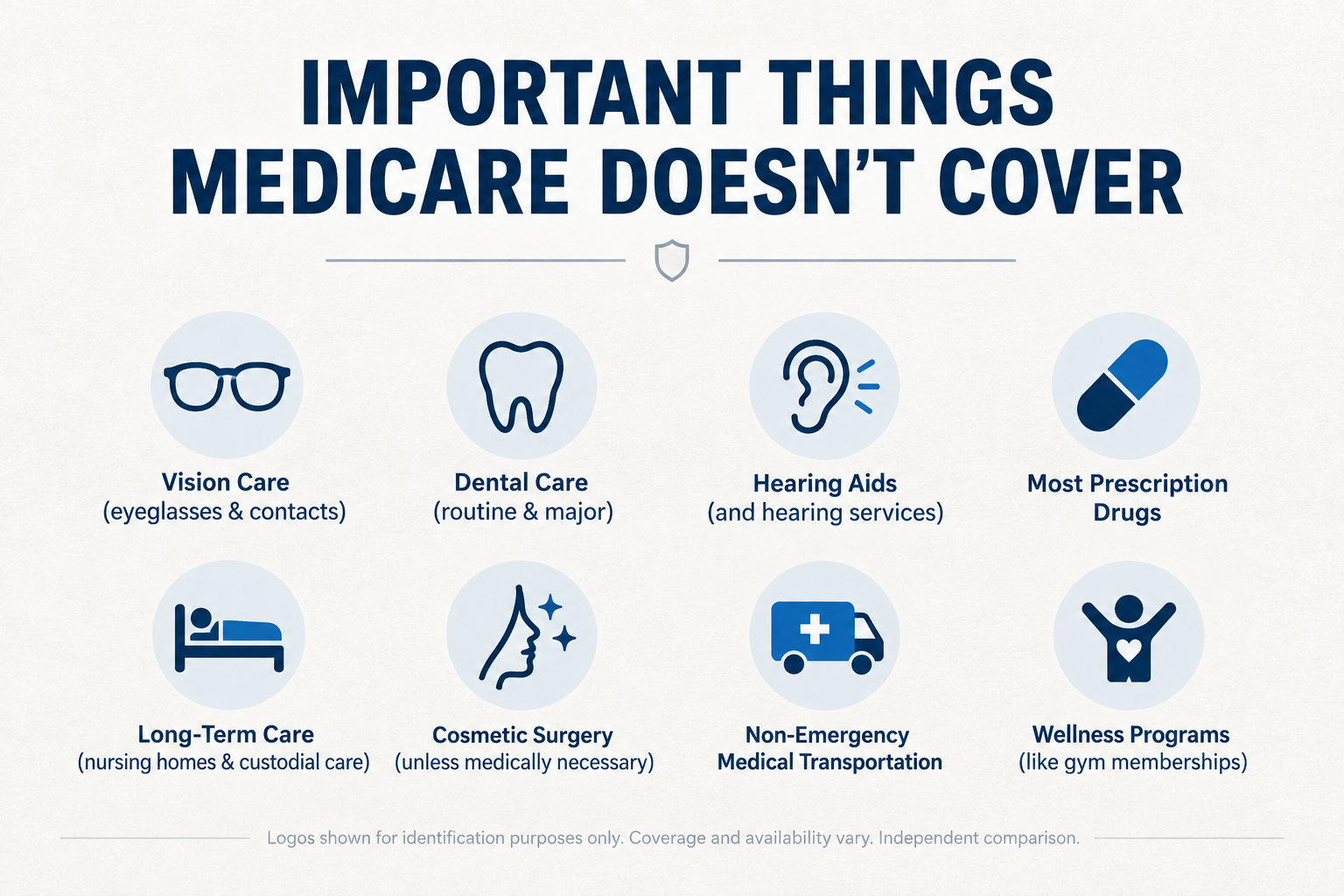
Understanding what Medicare doesn’t cover starts with identifying which kind of Medicare coverage you have. Original Medicare includes Part A and Part B, and it does not cover every health or support service. Medicare Advantage plans must cover the medically necessary services Original Medicare covers and may add supplemental benefits, but those extras vary by plan, county, eligibility, network, and year. Medigap mainly helps with certain out-of-pocket costs for Medicare-covered care; it does not turn every excluded service into a covered benefit.
Common Original Medicare gaps include most routine dental care, routine eye exams for prescription glasses, hearing aids and fitting exams, long-term custodial care, routine physical exams, massage therapy, concierge membership fees, most nonemergency care outside the United States, and many outpatient prescriptions unless you have Part D or another source of drug coverage. Exceptions can apply when a service is medically necessary and connected to a covered condition or treatment.
Quick guide to services Original Medicare may not cover
The phrase “not covered” can mean several things. A category may be excluded completely, covered only under a narrow medical exception, limited to certain settings or frequencies, or denied because the provider, supplier, documentation, or medical-necessity rule did not qualify. Always verify the exact service rather than relying only on the category name.
| Item or service | General Original Medicare rule | Important qualification |
|---|---|---|
| Routine dental care | Most cleanings, fillings, extractions, dentures, and routine dental services are not covered. | Limited dental services may be covered when closely related to certain covered medical treatments. |
| Routine vision | Routine eye exams for prescribing glasses or contacts generally are not covered. | Medicare covers certain medically necessary eye services and limited corrective lenses after qualifying cataract surgery. |
| Hearing aids | Hearing aids and exams to fit them generally are not covered. | Diagnostic hearing and balance exams may be covered when ordered to evaluate a medical problem. |
| Long-term custodial care | Ongoing help with bathing, dressing, eating, toileting, supervision, and similar daily needs generally is not covered when that is the primary need. | Short-term skilled nursing or home health may be covered when detailed eligibility rules are met. |
| Routine physical exam | A traditional head-to-toe routine physical generally is not a Medicare benefit. | The “Welcome to Medicare” preventive visit and yearly Wellness visit are different covered services when eligibility rules are met. |
| Massage and concierge fees | Massage therapy and membership or retainer fees for concierge practices generally are not covered. | Medicare may still cover qualifying medically necessary services furnished by an eligible provider, separate from a membership fee. |
| Care outside the U.S. | Original Medicare generally does not cover care outside the United States. | Narrow statutory exceptions can apply; some Medigap or Medicare Advantage benefits may address certain emergency travel needs. |
| Most outpatient prescriptions | Part A and Part B do not provide broad retail outpatient drug coverage. | Part B covers certain drugs in qualifying situations; Part D or other creditable drug coverage handles many retail prescriptions. |
Dental, vision, and hearing gaps
Most routine dental care
Original Medicare generally does not cover preventive cleanings, routine dental exams, fillings, crowns, bridges, root canals, extractions, dentures, or other dental services performed primarily to treat teeth. Medicare may cover certain dental services when they are inextricably linked to the success of a covered medical service, such as specified care before or during certain organ-transplant, cardiac, cancer, or dialysis treatment. The medical context, timing, and documentation matter.
Do not assume that a Medicare Advantage dental benefit works like comprehensive employer dental insurance. Check whether it covers preventive care, comprehensive procedures, dentures, implants, or oral surgery; whether an allowance or annual maximum applies; which dentists participate; which procedure codes are eligible; how often services can be performed; and whether prior authorization or coinsurance applies. Ask for a pre-treatment estimate for expensive work.
Routine vision and corrective eyewear
Original Medicare generally does not cover routine eye examinations performed to prescribe eyeglasses or contact lenses. It can cover medically necessary services for eye disease and certain screenings for qualifying people. After qualifying cataract surgery that inserts an intraocular lens, Medicare can cover one set of conventional eyeglasses or contact lenses from a Medicare-enrolled supplier, subject to Medicare rules and cost sharing.
A Medicare Advantage vision benefit may include a routine exam or an eyewear allowance, but verify the provider network, frequency, frames, lenses, contacts, fitting fees, upgrades, and amount owed above the allowance. A vision benefit is not a guarantee that every ophthalmologist, optometrist, optical shop, brand, lens coating, or medically necessary eye service uses the same network.
Hearing aids and fitting exams
Original Medicare generally does not cover hearing aids or exams performed only to fit hearing aids. Part B may cover diagnostic hearing and balance exams when a physician or other allowed health-care provider orders them to determine whether medical treatment is needed. The diagnostic service does not create broad hearing-aid coverage.
If a Medicare Advantage plan advertises hearing benefits, check the participating provider, eligible device models, technology levels, fitting and follow-up services, replacement frequency, loss or damage rules, batteries or accessories, and your cost above any plan amount. A low advertised copay may apply only to defined products through a contracted vendor.
Long-term care, custodial care, and home support
One of the largest misunderstandings is that Medicare pays indefinitely for nursing-home or in-home support. Medicare does not pay for long-term custodial care when the primary need is help with activities of daily living such as bathing, dressing, eating, transferring, toileting, meal preparation, transportation, or supervision. That gap can exist whether care occurs at home, in assisted living, in the community, or in a nursing facility.
Long-term care is different from covered short-term skilled services. Part A may cover a qualifying stay in a skilled nursing facility when Medicare’s eligibility, timing, skilled-care, certification, and approved-facility requirements are met. It is not an unlimited nursing-home benefit, and a person who needs only custodial help does not qualify merely because care is provided in a nursing facility.
Home health is limited to qualifying skilled needs
Medicare home health coverage can include part-time or intermittent skilled nursing, therapy, and limited home-health-aide services for an eligible homebound person under a qualifying plan of care through a Medicare-certified agency. Home-health-aide care is covered only when the beneficiary is also receiving qualifying skilled care. Medicare does not pay for round-the-clock home care, meal delivery, homemaker services unrelated to the care plan, or custodial personal care when that is the only care needed.
Private-duty nursing and assisted living
Private-duty nursing generally is not an Original Medicare benefit. Assisted-living room, board, supervision, and personal-care charges are not transformed into Medicare-covered expenses simply because the resident has chronic conditions. Medicare may still cover qualifying physician, hospital, therapy, equipment, or other medical services received by a resident, but that is separate from the residence and custodial-support charges.
Prescription drugs and other commonly misunderstood exclusions
Retail outpatient prescriptions
Original Medicare Part A and Part B do not provide broad retail prescription coverage. Part A covers drugs used during a covered inpatient stay. Part B covers certain drugs under defined conditions, such as some medications administered by a clinician, drugs used with qualifying durable medical equipment, and specified preventive or treatment situations. Many medicines filled at a retail or mail-order pharmacy require Part D or another source of creditable drug coverage.
A person with Original Medicare can generally add a standalone Part D plan. Most Medicare Advantage plans include Part D, but not all. Before choosing any drug coverage, compare the exact medication name, strength, dosage form, quantity, tier, deductible treatment, copay or coinsurance, prior authorization, step therapy, quantity limit, specialty-pharmacy requirement, and preferred-pharmacy status. Formularies and pharmacy networks can change for a new plan year.
Routine physicals versus Medicare wellness visits
Medicare’s preventive visits are often confused with a comprehensive annual physical. The “Welcome to Medicare” preventive visit and yearly Wellness visit focus on prevention planning, health history, risk assessment, measurements, screening schedules, and personalized prevention. They do not automatically include every examination, test, laboratory service, or problem-oriented evaluation that a person associates with a traditional physical. Additional services may create separate cost sharing.
Cosmetic surgery, routine foot care, and massage
Original Medicare generally does not cover surgery performed solely for cosmetic reasons. Coverage may be possible when treatment is medically necessary, such as repair after an injury or treatment of a malformed body part, depending on the facts and Medicare requirements. Routine foot care such as cutting corns or calluses and trimming nails generally is excluded, although exceptions can apply when systemic disease or medically necessary treatment meets Medicare rules.
Massage therapy is listed by Medicare as not covered. Chiropractic coverage is much narrower than many people expect: Original Medicare covers manual manipulation of the spine to correct a subluxation when requirements are met, but it does not create broad coverage for every chiropractic test, service, massage, or maintenance program. Acupuncture coverage is limited to qualifying chronic low back pain under Medicare conditions.
Concierge care and nonparticipating arrangements
Original Medicare does not pay a concierge, boutique, retainer, or membership fee. A physician may charge such a fee for noncovered amenities or access, but cannot use it to charge again for Medicare-covered services in a way that violates Medicare rules. Ask for a written description of what the membership fee buys and which services will still be billed to Medicare.
Medicare also generally will not pay for covered items or services furnished by a physician or practitioner who has opted out of Medicare, except under limited emergency or urgent circumstances. An opted-out practitioner typically uses a private contract with the patient. Read the contract carefully because the patient may be responsible for the full charge and cannot submit the service to Medicare for reimbursement.
Foreign travel, transportation, and convenience services
Original Medicare generally does not cover health care outside the United States and its territories. Narrow exceptions may apply, including certain emergencies near a border or travel between Alaska and another state through Canada when specific conditions are met. Do not rely on an exception without confirming the facts before travel.
Some Medigap plans include limited foreign-travel emergency benefits subject to the policy’s rules, cost sharing, time limits, and lifetime limit. Medicare Advantage plans generally do not provide broad worldwide medical coverage, although an individual plan may offer an extra benefit for emergency or urgently needed services outside the United States. Verify how to obtain care, pay the provider, submit a claim, and satisfy notice requirements.
Routine transportation to appointments is not a general Original Medicare benefit. Medicare covers ambulance transportation when medical necessity and other conditions are satisfied. Some Medicare Advantage plans may offer nonemergency transportation as a supplemental benefit, but trip counts, approved destinations, scheduling windows, vehicle type, escort rules, mileage, service area, and missed-ride policies can limit its usefulness.
Convenience expenses such as hotel rooms, family travel, home modifications, meal delivery, housekeeping, and personal transportation are generally not Original Medicare benefits merely because they support recovery. A specific plan or community program may address some needs, but the benefit’s eligibility and written rules control.
Ways to prepare for Medicare coverage gaps
No single product fills every gap. Start with the service you need, determine whether Original Medicare covers it under any medical exception, then examine other coverage. Avoid buying a plan solely because it advertises one extra benefit. The plan must still fit your physicians, hospitals, prescriptions, pharmacies, expected medical use, travel pattern, eligibility, and budget.
| Coverage source | Potential role | Important limitation |
|---|---|---|
| Medicare Advantage | Replaces Original Medicare administration and may include Part D plus supplemental dental, vision, hearing, fitness, transportation, or other benefits. | Benefits, networks, prior authorization, service areas, cost sharing, eligibility, and extras vary by plan and year. |
| Standalone Part D | Adds outpatient prescription coverage for people using Original Medicare and certain other eligible arrangements. | Formularies, tiers, pharmacies, restrictions, premiums, and member costs vary; enrollment timing and late penalties matter. |
| Medigap | Helps pay certain deductibles, copayments, or coinsurance for Medicare-covered services under Original Medicare; some policies include limited foreign-travel emergency benefits. | Generally does not cover long-term care, routine dental, routine vision, hearing aids, private-duty nursing, or retail prescriptions. |
| Medicaid | May assist eligible people with Medicare cost sharing and state-covered long-term services, dental, transportation, or other benefits. | Financial, functional, and program eligibility plus covered services differ by state and individual circumstances. |
| Employer, union, or retiree coverage | May coordinate with Medicare and provide drug or supplemental benefits. | Changing Medicare coverage without checking the benefits administrator can affect the retiree or dependent coverage. |
| Separate private coverage | Dental, vision, hearing, travel, or long-term-care products may address selected risks. | Exclusions, waiting periods, networks, benefit limits, eligibility, underwriting, and premiums require careful review. |
Use a service-by-service verification process
- Write the exact item, procedure, provider, setting, and reason it is needed.
- Ask the provider whether the service is Medicare-covered and whether the provider accepts Medicare assignment.
- Request the expected billing codes and an estimate of your share.
- Ask whether a coverage exception, order, referral, prior authorization, or medical-necessity rule applies.
- For Medicare Advantage, confirm network status and authorization with the exact plan.
- For prescriptions, verify the formulary, tier, restriction, and pharmacy.
- Review any written notice that says Medicare may not pay before receiving the service.
- Keep the estimate, order, authorization, plan document, and appeal instructions.
If you search for Medicare coverage help near me, remember that an insurance agent can explain represented private options but does not decide whether Medicare covers a claim. Use Medicare.gov, 1-800-MEDICARE, the provider, or your plan for official coverage determinations. SHIP offers counseling that is not connected to an insurance company or health plan.
The form requests help from Blake Insurance Group and does not enroll you in a plan. Plan availability and benefits depend on service area, eligibility, contract, and plan year.
Frequently asked questions
Does Medicare cover dental care in 2027?
Original Medicare covers only limited medically connected dental services
Most routine dental exams, cleanings, fillings, crowns, dentures, and extractions are not covered by Original Medicare. Certain dental services may be covered when closely related to specified Medicare-covered medical treatment. A Medicare Advantage plan may offer dental benefits, but its exact procedures, network, frequency, and limits must be verified.
Does Medicare pay for hearing aids or routine eye exams?
Original Medicare generally excludes these routine services
Original Medicare generally does not cover hearing aids, hearing-aid fitting exams, or routine eye exams for prescription eyewear. It covers certain diagnostic hearing services and medically necessary eye care when requirements are met. Some Medicare Advantage plans may add limited routine benefits.
Will Medicare pay for assisted living or a nursing home?
Medicare does not provide general long-term custodial-care coverage
Room, board, supervision, and help with daily activities generally are not covered when custodial care is the primary need. Medicare may cover qualifying short-term skilled nursing or medical services under detailed rules. Medicaid or other resources may help eligible people with long-term services.
Does Medigap cover services Original Medicare excludes?
Medigap mainly helps with cost sharing for Medicare-covered care
Medigap generally does not cover long-term care, routine dental or vision services, hearing aids, private-duty nursing, or retail prescriptions. Some policies include limited foreign-travel emergency benefits. Review the exact standardized plan and policy terms.
Can a Medicare Advantage plan fill every Original Medicare gap?
No supplemental benefit is automatically comprehensive
A Medicare Advantage plan may add selected dental, vision, hearing, transportation, fitness, or other benefits, but it does not necessarily cover every excluded service. Eligibility, networks, allowances, frequency limits, prior authorization, covered items, and expiration rules can restrict use.
Does the Wellcare button compare all Medicare coverage options?
No, it is a Wellcare-only Medicare Advantage pathway
The supplied link is not Medicare.gov and does not compare every carrier or plan. Use it only to explore Wellcare options after confirming the correct 2027 plan year, service area, eligibility, providers, prescriptions, costs, benefits, and election period. The Blake form requests assistance but is not enrollment.